
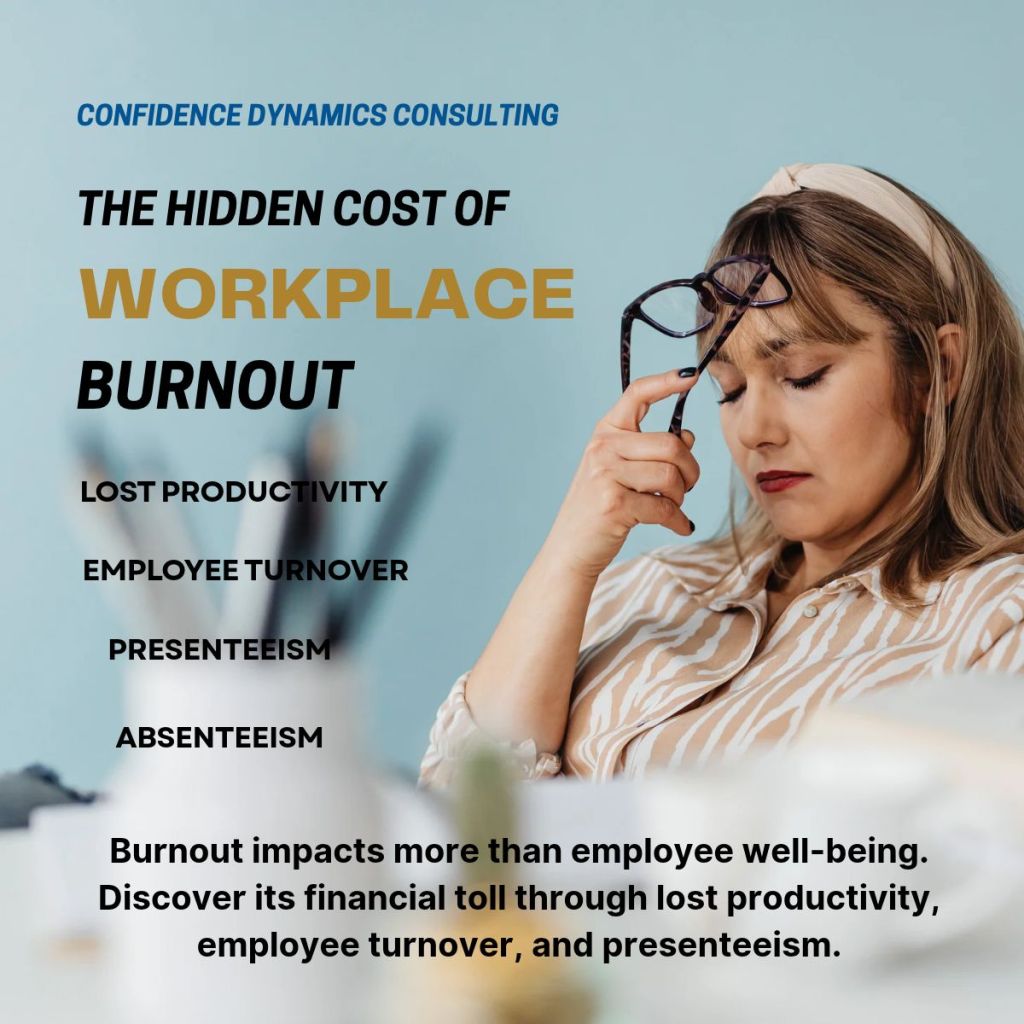
In 2026, it is no stretch to say that organizations need to address the growing burnout challenge, which costs millions annually in lost productivity, attrition, presenteeism, and turnover.
Introduction
Burnout among US workers has risen since 2020. A 2023 survey found that some level of burnout was prevalent among 59% (Martinez et al., 2025). Although anecdotal, my experience with clients suggests it is higher in 2026.
One of the largest national industries, health care experiences high rates of burnout. A study of over 2,300 physicians examined the connection between work control and burnout. The study found that 37.4% of physicians reported poor work control, and 64% of the connection between poor work control and intent to leave was connected to burnout (Sinsky et al., 2026). Ten out of 500 may not sound like a lot, but consider the risk a disengaged physician can pose to healthcare outcomes.
Beyond organizational costs, the individual worker also pays a human cost. Almost 20% of American workers rate their mental health from poor to fair. Within this group, work absence is four times higher than among those with good mental health (Witters, D & Agrawal, S., 2022). So is it the work or pre-existing mental health issues that cause burnout? It is likely a mix of both, but 4 out of 10 workers stated that their job negatively impacted their mental health. At the same time, those with fair to poor mental health missed close to 12 days of work per year, compared with 2.5 days for those reporting good to excellent mental health, according to a recent Gallup survey (Witters, D & Agrawal, S., 2022).
The Financial Cost of Burnout
Poor working conditions cause significant economic damage through decreased productivity from presenteeism, medical leave, missed days, and escalating replacement costs (Martinez et al., 2025; Sinsky et al., 2026). These conditions weaken organizational effectiveness and efficiency. Annual health insurance premiums for employers are $7,034 for individuals and $17,393 for families, while employee burnout costs are estimated at $3,999 to $20,683, equaling or exceeding health insurance costs. Employee burnout costs are 3 to 17 times the average employer investment in employee training, which averages just over $1,200 (Martinez et al., 2025). The US economy loses almost $48 billion a year in lost production due to employee mental health decline (Witters, D & Agrawal, S., 2022). Imagine a GDP number where employee mental health is not a significant issue.
The Cost of Employee Turnover
As mentioned, healthcare-related work has high burnout. Physician burnout costs range from $6,000 to $8,000 per physician (Khalili et al., 2025). Physician staffing costs are just under $90,000 per departure, with replacement costs between $500,000 and $1,300,000 (Sinsky et al., 2026).
While lost productivity, attrition, presenteeism, and turnover costs are key issues in burnout, as a business owner, my first thoughts about burnout often center on turnover. How much do hours and training expenses add up to when interviewing and training a new employee, compared with retaining the one you already have and leveraging their experience? One can reflect on new positions taken and the excitement of new responsibilities, opportunities, and the passion for career growth. Unfortunately, in my experience working with clients, this often turns into disillusionment as duties pile on beyond reasonable expectations, and soon burnout and resignation follow.
Quiet Quitting and Presenteeism
Today, a new term is entering the cultural lexicon: “Quiet Quitting.” Quiet quitting does not mean an employee quits their job; rather, they show up and put in minimal effort and energy. Quiet quitting is relatively new, and research on its specific costs to organizations is still limited. Quiet quitting is more about the cost of missed opportunity from decreased effort, inflexibility, and lack of voluntary help (Magrizos et al., 2026). Loss of production can spread through teams, workflows, and project deadlines, something not reflected in a Quiet Quitter’s wages or salary (Pauly et al., 2008).
Quiet Quitting may often morph into another deep-rooted phenomenon: presenteeism. Presenteeism describes employees showing up for work despite impaired physical and mental health, reducing their productive ability (Atiq et al., 2026). Another cost of both presenteeism and quiet quitting is the impact on other employees who have to pick up the slack from those doing the minimum, creating a catch-22 where even non-slack carriers can become burnout candidates.
Presenteeism is estimated to account for almost 90% of disengagement and burnout costs to organizations. A typical thousand-person organization can absorb about $5 million in disengagement and burnout costs. Managers and leaders account for just under 30% of these costs while only making up just under 12% of the workforce. In a thousand-person firm, disengagement and burnout affect presenteeism for about 67,000 days a year. Costs per employee are just under $4,000 for hourly non-management roles and just under $21,000 for executive leadership roles (Martinez et al., 2025). Burnout among a relatively small number of managers/leaders is costly.
Recognizing the Warning Signs of Burnout
Leadership and employees would benefit from understanding how burnout progresses. The Markov States (defined categories in research) used in the 2025 study on the health and economic burden of employee burnout provide a useful guide to detecting the stages leading to burnout.
1. Engaged: In the engaged state, exhaustion and cynicism are minimal; work is satisfying, and there are no associated health costs.
2. Disengaged: In the disengaged stage, high levels of cynicism emerge, linked to stressors from a lack of rewards, perceptions of fairness, and misalignment with company values.
3. Ineffective: In this stage, employee productivity and morale drop, and employees struggle to manage work stressors. Heavy workload is a key stressor.
4. Over-Extended: The Over-Extended stage is marked by high exhaustion. Workload and psychological environment are key stressors.
5. Burnout: Burnout is the combination of all stages into one. It is characterized by low productivity, high cynicism, and high fatigue. Additionally, employees feel emotionally disconnected from their work and no longer find meaning in their jobs. In a burnout state, individuals are more susceptible to external factors such as relationship and family challenges, financial stress, and related health issues (Martinez et al., 2025).
Conclusion
Burnout develops over time and has common signs. Financial consequences can begin as burnout develops, with decreased productivity. When burnout leads to employee resignations, productivity falls further because recruiting and training a replacement delays the return to productivity goals. Organizations that recognize these warning signs before burnout takes hold will be better positioned to outperform those that ignore it.
About the Author
James A. Weisbecker, MS, LPC, is the founder of Confidence Dynamics Consulting, where he helps organizations reduce burnout-related performance problems through workshops, speaking, and consulting. He is a licensed professional counselor and EMDR-certified clinician, and he spent 20 years in B2B sales and 11 years owning a martial arts school before his clinical career. He also hosts the Meet Your Mental Helper podcast.
Contact: confidencedynamicsconsulting.com | confidencedynamicsconsulting@gmail.com | linkedin.com/in/jamesweisbecker
References
Atiq, A., Sullman, M. J. M., Apostolou, M., & Lajunen, T. (2026). The psychological architecture of employee disengagement: A structural model of the antecedents and behavioral outcomes of quiet quitting. Frontiers in Psychology, 17, 1813041. https://doi.org/10.3389/fpsyg.2026.1813041
Khalili, J., Miotto, K., Wang, T., Mafi, J. N., Kyababchyan, E., Sanford, J., Elashoff, D., Brook, J., Adebambo, Y., Smith, P.-A. I., Nguyen, E., & Yoo, S. M. (2025). Professional Coaching to Reduce Physician Burnout: A Randomized Clinical Trial. Journal of General Internal Medicine. https://doi.org/10.1007/s11606-025-09653-w
Magrizos, S., Aydinliyim, L. E., Roumpi, D., Porter, C. M., Phillips, J. M., & Delery, J. E. (2026). The Disquiet of Quiet Quitting: Definitional Clarity, Theoretical Pathways, and Future Research. Human Resource Management, 65(4), 1015–1032. https://doi.org/10.1002/hrm.70061
Martinez, M. F., O’Shea, K. J., Kern, M. C., Chin, K. L., Dinh, J. V., Bartsch, S. M., Weatherwax, C., Velmurugan, K., Heneghan, J. L., Moran, T. H., Scannell, S. A., John, D. C., Shah, T. D., Petruccelli, S. A., White, C., Dibbs, A. M., & Lee, B. Y. (2025). The Health and Economic Burden of Employee Burnout to U.S. Employers. American Journal of Preventive Medicine, 68(4), 645–655. https://doi.org/10.1016/j.amepre.2025.01.011
Pauly, M. V., Nicholson, S., Polsky, D., Berger, M. L., & Sharda, C. (2008). Valuing reductions in on‐the‐job illness: ‘Presenteeism’ from managerial and economic perspectives. Health Economics, 17(4), 469–485. https://doi.org/10.1002/hec.1266
Sinsky, C. A., Brown, R. L., Rotenstein, L., Shah, P., & Shanafelt, T. D. (2026). Estimating the Cost of Poor Work Control Among Physicians in the United States. Mayo Clinic Proceedings, S0025619626185917. https://doi.org/10.1016/j.mayocp.2026.05.017
Witters, D & Agrawal, S. (2022, December 13). The economic cost of poor employee mental health. Gallup. https://www.gallup.com/workplace/404174/economic-cost-poor-employee-mental-health.aspx


Leave a Reply